
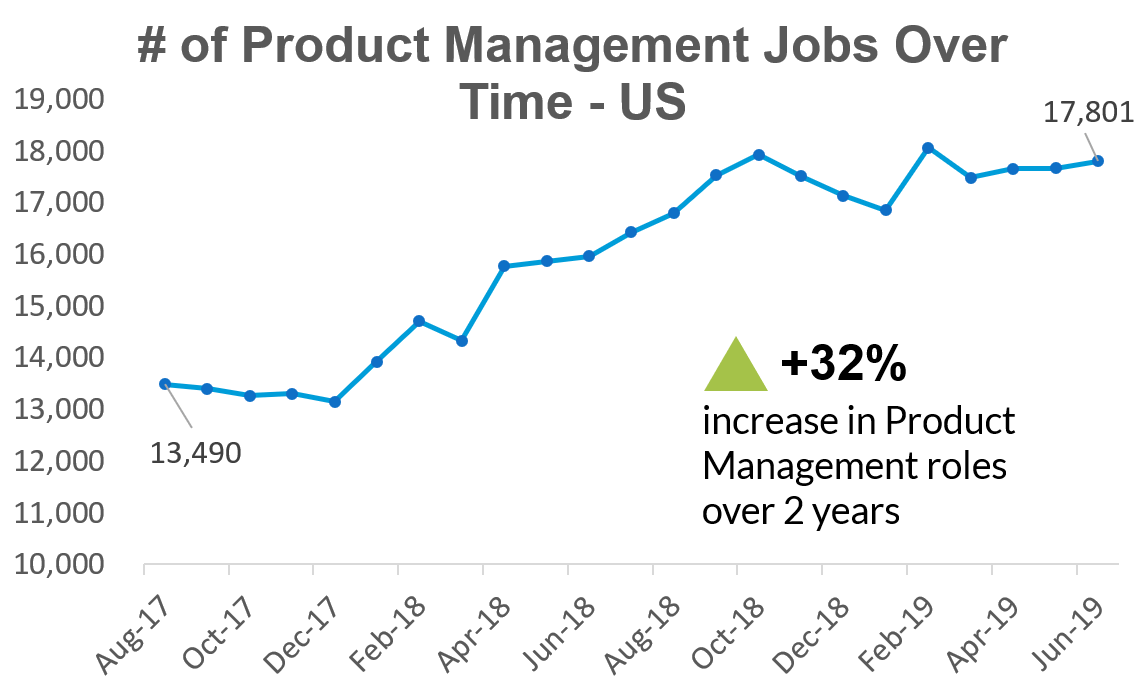
Product management is one of the fastest-growing job roles in the world. The demand for project managers has doubled across these past five years, and it’s hard not to see why:
First off, PMs are the point people for all projects within a company. As such, they’re critical to every business operation today —their success is tied to the company’s success.
They aren’t just responsible for overseeing product development —they often take on both strategic and tactical decision-making as well.
In fact, one study found that companies with good project managers can expect a 34% increase in profits. So it’s no surprise that Glassdoor has ranked the product management position as the 10th best job in the US, with nearly 18,000 job listings at the time of this writing.
But what about the money?
How much do they actually make?
In an analysis of 40,711 salaries, Glassdoor found that product managers are earning an average base pay of $102,289 in the US. And the same happens all over the world —globally, they have an average salary of $120,000 – $150,000
Now, if we want to get specific, it turns out that there’s a lot that goes into determining how much a product manager makes —and it’s not just about how long they’ve been in the business or whether they have experience with certain technologies or products.
It also depends on where they live and what kind of company they work for.
To help you figure out just exactly how much you should be making as a product manager, I’m going to dive into what exactly a PM does and the salary breakdowns for each industry, experience level, and location.
Let’s get to it!
What’s the role of a Product Manager?
With the rise of AI and automation, businesses are looking for ways to keep up with their customers’ changing needs.
That’s where the product manager comes in.
The PM’s job is to listen to what customers want, understand how the market is evolving, and figure out how to respond by bringing products and services to the market that address those needs.

Product managers can take on many roles in the development process, including strategizing the product and its features, designing the product roadmap, pinpointing the product’s technical requirements, and creating and implementing its marketing strategy.
They are also responsible for making sure that all of these steps are carried out efficiently and effectively. In order to do this, PMs need to have a broad understanding of the business side of things as well as engineering and design.
In addition, product managers act as liaisons between their company’s leadership team (including executives) and other members of their organization who are responsible for implementing new or existing products into their companies’ processes or systems.
Breaking Down the Product Manager Salary By Experience

There’s no one-size-fits-all when it comes to product management salaries. But one thing is clear: experience matters.
This is pretty straightforward —if you’re applying for an entry-level position and have no prior experience, you shouldn’t expect to be making as much as someone who has been doing this type of work for years.
But as you gain more experience, you’ll likely move up to more senior positions with more responsibility and higher salaries.
On the other hand, a surprising number of product managers are still new to their careers, with 33% having less than 4 years o